Showing posts with label dear family volley. Show all posts

Monday

Tattle-Taling and A Printable

The last few weeks in our house have been filled with too much tattle-taling.

"Mom, she won't play with me."
"Mom, tell him to stop touching that"

"MOM...."

Sound Familiar?

So, I called a family meeting and we sat down to talk about all the tattling. We had talked about tattling before, but this time I decided to use a new approach. To educate our kids.

We taught the kids the difference between "Informing" and "Tattling".

It has only been one week and there has been a marked difference in our kids behavior. Hope it can help you too.


This is modified from a handout I saw at our son's school.

Note added 07/28/2012: This printable and it's content, is a modification of a handout that I saw at our son's school. It has since been brought to my attention that it is originally from material created by SuEllen Fried A.D.T.R. From what I have been able to deduce, you can find the content in her book "30 Activities for Getting Better at Getting Along". You can find more information on her site, BullySafeUSA.com

I worked through each of the characteristics on the list above. As we went, the kids had lots of "...but what if..." questions. We answered every one so that the differences were clear and I felt confident they understood. 

We gave examples of what might be important, or unimportant, or what might be dangerous etc... We talked for over an hour. It was great. 

The sign is now posted in our kitchen, and also in our playroom so that the kids can refer to it when they are trying to decide if they are tattling or informing. I also asked them to refer to the chart first, before they start hollering my name. ;)

I have tried to make the information into a printable for you. Not sure how successful I have been, but my hope is that you can drag the image to your desktop and then print it off if you would like to put it in your house, or in your classroom, or even use it for Sunday School.

Where can you put this chart in your house?
Do your kids need to learn the difference between "informing" and "tattling"?


Commitment - Part 2 of 5

Second post in a series of parenting tips.... All starting with the letter "C".
Last week we talked about Choices, and the importance of giving our children choices. 

Today we are going to talk about Commitment. 

What does it mean to commit. Commitment means to engage oneself, and to be involved.

When our kids are acting out, our thought isn't usually to be more involved with them. We usually want to NOT be engaged with them.

It is natural to think this way. When our kids are misbehaving, we aren't thinking, "...go get Candy Land, I would love to play a few games", or "...everyone in the car, let's go to the park.". When they are misbehaving we are not thinking about how much we want to listen to them.

But...we should. If we want the misbehavior to stop, and our relationships to strengthen, then we as parents need to make a commitment... FIRST!

Yep, instead of waiting for our kids to be better, we need to commit to them first.

This is how commitment works. As parents, we show commitment to our children FIRST.  Then, and only AFTER we have shown them our commitment, they will be willing to commit back to us as parents. They are willing to trust us, to behave, to listen, to compromise, to obey.

Think about it, aren't we the same way as adults? When people don't give us their time, or energy, when they don't commit and contribute to our friendship or relationships, do we feel the need to serve them, or commit to them and the relationship? Nope, we don't.

Once we commit to our children, they will commit back to us as parents, and to the family. 

How Do Our Children Understand Commitment?
Each of our children will interpret our commitment differently.

Let me explain.
Our son feels commitment from me when I LISTEN. Really listen. This means that when he wants to tell me a story, or about a new invention, I STOP what I am doing, and listen. He knows I am committed to him when I sit at eye level and look into his eyes while he is talking.

Our daughter is totally different. She feels commitment from me when I DO things with her. When we play, read, go for walks, go to the park, when I go to her activities, go...go...go... That is when she feels I have committed to her. When I am active with her.

They are totally different in their feelings... BUT their behavior when they don't feel my commitment is the same. They don't want to focus on their homework, they complain, they drag their feet about household work, and have less patience when I ask them to help. They get bossy, have bad attitudes, and there is a lot of complaining and tattle tailing. Sound familiar?

When they don't feel my commitment to them, they don't feel the need to contribute to our relationship either. A.K.A, they misbehave.

Tips For Committing To Our Children

  • Determine how your children feel commitment. Is it when you play with them, listen to them, take them places? Is it when you show affection to them, or let them choose, or give them freedom to explore? Figure out what they need to feel your commitment to them.
  • Plan of Attack. Once you determine how your children feel commitment, create a plan of action. This will not be a cookie cutter technique. Each child is different. 
Write down your child's name, then how they feel commitment. Next, write down 5 ways you can show that commitment in 15 minutes or less. Lastly, write down 5 ways you can show that commitment in longer activities (over an hour).

SO... next to our daughter's name I have written: color with her, play school (she is the teacher) walk around the block, jump rope in the garage, browse through her American Girl Doll Catalogues with her. For her longer activities, go to the park, go to the library, go to the indoor track, walk to the temple, paint.
  • We need to take responsibility for their misbehavior. Hard to accept, but we could be provoking their misbehavior, by not showing them our commitment. It happens. It's okay. But instead of sitting back and pointing fingers, let's put the housework down and be the change we are looking for. 
  • Our kids know best. It is natural to want to show our kids commitment in our way, not theirs. Avoid this. It is not about us. It is about what they need. Even if we don't understand, give them what they need and want. I can try to convince our daughter all day that talking to one another is commitment. At the end of the day, because it wasn't more active, she will still feel dissatisfied. 
  • Let go of the perfection mentality. If we wait for the perfect time and situation to be with our children, we will never be with them. It will never be perfect. Stop waiting and act.
  • Be in the moment. I doubt any of our children would say they feel our commitment when we multitask. Put everything down and commit your time, thoughts, actions, and heart, to your children.
  • Commit to 15 minutes a day. Remember this post on one-on-one time? Now is the time. Make the decision to commit to your child every day. Give them you. That is what they want more than anything. Isn't good behavior worth 15 minutes a day? Twice a month, participate in a longer activity with your child.

We have said it before, Love is spelled T-I-M-E. Want to see improvement in your children's behavior? Commit to them FIRST! By being engaged and getting involved. Then watch the behavior transform.

How do your children feel commitment?

Give them "Choices"- Part 1 of 5

Over the next few days, I will be sharing parenting tips that start with the LETTER "C". 
Today, CHOICE

Usually when we think of our kids misbehaving, our first thought is not, "let's give them more choices". Perhaps it should be.

If we put ourselves in our children's positions for just a minute, we can quickly see that we are always telling them what to do.
When to eat.
When to sleep.
What they can play with.
What they can't play with.
When they can go to the bathroom.
When they can go outside.
What they can do during the day.
What they can't do during the day.
What they can wear, and what they can't.

The list goes on and on. I know that if someone was telling me what to do like that, I would want to act out. I would feel frustrated and want to rebel. I would feel powerless over my own life.

Our kids struggle with those same feelings. They can feel as though they have no choices, no say, and therefore they feel like they have no control over their lives. Feeling like there is no control leads them to acting out.

Choices help our kids....

  • Feel in control of their own lives.
  • Improve behavior.
  • Take ownership over their choices
  • Makes them feel important.
  • When they choose, they are more likely to follow through and own up to the choice, because they made it themselves.
  • Learn to make good decisions.

We are not implying that they need to choose everything all the time, but we need to give them the opportunity to choose.

Tips for offering Choices

  • Choices should be age and ability appropriate. 
  • Offer choices to help avoid conflict. If you know getting dressed in the morning brings contention, offer your daughter her choice of shirts. Would you like to wear the red shirt or the pink shirt? 
  • Don't offer a choice, when there isn't one. Brushing teeth IS NOT a choice in our house, but brushing before or after putting on pj's IS a choice. 
  • Offer choices when kids are being good, not just when there is misbehavior. This is really important and kids will be less likely to misbehave in the first place. 
  • Two choices are enough. When our daughter chooses her shirt for the day, I give her two shirts to choose from, not 4.
  • Let go. Sometimes, our ego's can make things worse. It is okay to let our kids decide. Bossing them around and making all the decisions, doesn't make us better parents. 
Want to see improvement in your child's behavior? Offer choices.
What choice can you give your child today?
Is it hard for you to offer choices?

Struggle with getting your kids to eat their veggies? Offer choices and stop the veggie battle. 

Friday

FAMILY FUN FRIDAY-Master Questioner?


In this game, what ever you do, don't answer the questions!

Master Questioner?

You don't need anything to play this game, and the rules are very simple.

How to Play
*Have everyone sit in a circle so that you can easily see each other.

*One person begins by asking another player a question. Any question.

*That player then (responds) by asking another player a question.

*A player is out if a question is repeated, they answer the question, or hesitate to ask a new question.

*Last person in the circle wins.

EXAMPLE
My husband starts by looking at our son and asking a question. He says, "How old are you?"
Our son (responds) by looking at me and asking "What time is it?"
I (respond) by looking at my husband and asking "Why is the sky blue?

We continue to ask each other questions until someone messes up. Messing up means you answer the question (instead of ask a new one), repeats a question, or hesitates to ask another question.

Resisting the urge to answer the questions you are asked is the hardest part of the game! You and your family will have a blast with this one. 

It is also great for riding in the car. Modify. Because you can't all look at each other while driving, start each new question with the persons name. "Heather, why is the sky blue?" "William, what did you have for lunch?" Then you will know when someone is directing the question to you. 

I hope you and your family have a great weekend. I know I have some catching up to do. If you fell behind on the photo challenge this week (like I did) no worries. It is never too late. Take a picture of a "childhood memory" and catch up. 

FAMILY FUN FRIDAY-Red Nosed Reindeer!

You will love this game. It is perfect for the holiday season. Think of it as a Christmas version of Shoveling Snow. 

YOU WILL NEED
Red Pom Poms
Because Rudolph was a red nosed reindeer. 
In a pinch, any color could be used here also.


Vaseline
 Red Ribbon
Any color ribbon will work, but red is great because it is christ-mas-y.
Reindeer Antlers
Although not necessary to play, they would be a very festive addition if you happen to have some sitting around. 

PREPARATION
1. Take your red ribbon and cut it about 15 or 16 inches long. Small children will need a shorter ribbon. 

2. Attach a pom pom to the end of your cut ribbon. A hot glue gun would be perfect for this job. 

3. If you have reindeer antlers, have the first player put them on their head.


LETS PLAY
1. The first player, using only their nose, has to dip their nose in the Vaseline. the more vaseline, the better. Players are NOT allowed to use anything but their nose, to apply the vaseline. That includes using their hands to hold the vaseline container. 

2. Once the player has vaseline on their nose, they take the ribbon (the end without the pom pom) and hold the very end in their mouth. No cheating here. Grab that ribbon right down at the end. The ribbon should be hanging down towards the floor with the pom pom at the bottom. 

3. Now comes the challenge. The player, must swing the ribbon/red pom pom and get the pom pom to stick to their nose. 

RULES TO REMEMBER
1. The pom pom and ribbon cannot touch any other part of the players body, except their nose. If it touches another body part, or another part of the players face, and sticks to their nose, it doesn't count.

2. NO HANDS ALLOWED. If a player touches the pom pom with their hands, their turn is over. 

TO KEEP SCORE 
(aka HOW TO WIN)
1. Set a time limit and see how many times each player can stick the pom pom to their nose in the given amount of time. 

2. Set a number limit. For example 10. Time each person and see how long it takes them to get the pom pom to stick 10 times. Who ever does it the fastest is the winner.  

Family Members young and old will love this game. Perfect for upcoming Seasonal, family gatherings. If you play, be sure you take pictures. I would love to see all the fun you are having.  

Do you have any fun weekend plans? What are you and your family doing this weekend?

Wednesday

TV Debut-Thanksgiving Traditions-Why I Have Been MIA

I feel like I have been Missing in Action.

Why? Well, on Monday I had a fun opportunity to be on Studio 5, here in Utah. I shared some Thanksgiving Traditions that encourage gratitude. It was a blast, but, there was a lot of preparation. Hence being MIA. Any spare time was spent prepping and planning.

Not bad for my first shot at live TV. Although there were a few things I didn't get to say, but that is how TV works. You role with it.

Give it a watch. Tell me what you think. Tis the season of Gratitude and the video will give you some great ideas just in time for your Thanksgiving Dinner. Especially the "Gratitude Rolls".


p.s. Watch the Studio 5 video and you can see the headband trick in action. The video is working again, with no charges. I wrapped it very tight, tighter than usual, but still loved the way it turned out. Here is how it looked last time I took pictures for you.

Monday

Avoid the Red Pen-Follow the 90/10 Rule


The summer between my first and second year of graduate school, I was asked to take a TA class. As a graduate student we were often assigned to help a professor, and those responsibilities could include grading papers, or anything else they needed help with. We needed training.

One of the very first things they taught us was to AVOID THE RED PEN. They taught us not to use a red pen when we were grading papers or assignments. They suggested that any other color, even pink or orange would be better.

I thought this was funny. Every teacher I think I ever had in high school used a red pen to mark mistakes and incorrect answers. (And some in college too..)

They went on to teach us how a red pen immediately puts someone on the defensive. It makes the mistakes stand out over the things the student might have gotten right. This discourages the student. The color itself makes us feel negative.

They also taught us that when grading a paper, we should always try to SAY SOMETHING POSITIVE FIRST, before we made a negative comment on what we were grading.

Not only have these principles helped me as a teacher, but they have also helped me as a parent. They can help all of us.

How?....

AVOID THE RED PEN- don't constantly point out our children's shortcomings. We don't need to spend all our time with our children pointing out what they are doing wrong or need to do better. Sure, there are times when we need to, but not all the time. Don't be nit picky. Constantly pointing them out is like using a red pen instead of a blue one. Our kids grow up with their mistakes glaring in their face. That is discouraging, and immediately puts them on the defensive. And, it makes them feel like doing something good won't matter, because all we point out is the bad. This also means that we don't point out their mistakes to others. Use a blue pen, make the bad less obvious and praise the good.

SAY SOMETHING POSITIVE FIRST- When we talk to our children, always start with a positive statement. Then you can follow it up with the problem. Sometimes the only positive we might have to say is "I Love You". That's okay. Don't let yourself say something negative or reprimanding until you have said something positive.

Our goal should be to make 90% of our conversations with our kids POSITIVE. With only 10% negative, reprimanding, and correcting. 

Evaluate how you are talking to and "grading" your kids. Are your conversations filled with red pen? Do you follow the 90/10 rule?

These simple principles will strengthen our relationships with our children, and we will find that they will be better behaved.

What color pen do you use?
Do your conversations follow the 90/10 rule?

Tuesday

Making and Keeping Memories-School Year TIME CAPSULES

Early FAMILY FUN FRIDAY
I tried so hard to have this up yesterday. Just didn't happen. Better late than never.
Image Via Pinterest

Well, our new school year has started off with a bang. The kids had a great first day of school. Both of our kids changed schools this year.

Our daughter just started first grade and is in a French Immersion Program. Half of her school day is only in French (including Math). No English will be spoken by the teacher. She already came home after the first day, spitting out French phrases and introductions. Little minds are amazing.

I can't get over how fast our lives are changing and our kids are growing. I am sure I just got married. Actually, I still feel like I am 19. But I am not. 10 years of marriage and 4 kids later, life is flying by and sometimes I don't feel like I am making time to document the growth and changes. So I am changing that.

Here is a great little family activity, perfect for the start of a new school year. It will help you keep track of your children's growth, without taking a lot of time or resources. And your kids will love it. Don't worry if school has already started. There is plenty of time and your kids will still be very willing.

SCHOOL YEAR TIME CAPSULES
The idea is to document the small things about your child that will change over the next school year. Things like height, weight, likes and dislikes, even handwriting. 

You don't need much.

A container
Rope or string or ribbon
Paper
Pens/Pencils
Camera

First...decide what you want each child to keep their capsule in. Our daughter is going to use a Mason jar, our son chose an old shoe box, our youngest is going to use a #10 can. (Even though she is not in school, she doesn't want to be left out. :)

HEIGHT
Have your child stand up against a wall and lightly mark how tall they are. THEN...take your rope/string/ribbon and stretch it the length of your measurement. Cut the string to the right height length, and put it in your time capsule. They will love getting it out at the end of the school year and seeing how tall they have grown. 

WEIGHT
Write down how much your child weights. If you don't know, don't worry, skip this one.

LIKES/DISLIKES
On a piece of paper, have your child write down the following... 
favorite color
favorite meal
favorite fruit
favorite vegetable
favorite activity
least favorite food
favorite tv show
favorite movie
favorite book
favorite subject in school
favorite friend
favorite snack
favorite shirt/pants/shoes
favorite toy

You get the point. Add your own to the list. 
(I need to learn to make printable pdf's for you and then you could print off a template. I will put it on my to-do list)

GOALS
Have your child write down 3 goals they have for this school year. At the end of the year you can see if they accomplished those goals. 

HANDWRITING
Have your child write their name. For even more fun. Have them write it on a piece of paper/chalkboard/whiteboard and then take of picture of them holding the piece of paper up. This way you will have a picture of them and see what their writing was like. It will be fun to see how their writing has changed at the end of the school year.

TRACE HANDS/FEET
Trace your children's hands. Include the tracing in the capsule. Your kids will love to see how their hands have grown. We like to include feet also. 

PICTURE
If you took a picture of your child holding up their name, then you can use that as your picture. If not, you probably took a picture the first day of school. Add a picture to the time capsule and you are set. 

Once you have everything filled out and gathered, put it in your container of choice and seal it up. We have thought about burying ours in the backyard, but that is still up for debate. just tuck them away until the end of school. 

It will be so fun to have a special START OF SUMMER PARTY next year when we open them up and see how the kids have grown and changed. 

THE ULTIMATE GOAL
We have decided that we are going to do this every year until they graduate from high school. I will keep every year in a special box and when they graduate, we will have a nice little history. Our own way of keeping a journal. And each child's can be stored in a very small container because there is nothing bulky or big about what we are storing.

Simple, fun, and memorable. It doesn't get better than that. 

How do you keep your memories?
How do you ring in the new school year?


Taking Baby Steps


I always get questions from concerned parents who think their children should "already be walking". As parents we really worry about our child's physical development. It is easy to look around and compare our children to other children who are already on the move. Or compare them to their siblings. We have to remember that every child is different. They will develop and decide to move when they are ready. For the most part, we need not worry. Instead, we want to enjoy every little development and stage.
That said, here are some GENERAL GUIDELINES for mobile development. I hope they provide some piece of mind.

Birth to 3 Months
Squirmers
When babies are first born they don't know how to tell their muscles that they want to move around. Although they will move arms and legs, turn their heads when they are laying on their backs, and can bring their hands to their mouths, these are responses to their environment, more than they are deliberate movements and commands. For new little ones to develop more advanced motions, they have to build their core strength. This means they need TUMMY TIME. Tummy time should start as soon as you return from the hospital. Put your baby on his/her belly a few times a day. By 3 months, they should spend about 1 hour a day on their tummies. This time can be broken up into increments. Some babies don't like tummy time. Be sure your baby is awake and has been fed, and if they continue to fight, try putting them across your legs on your lap. That counts also. You will quickly see their strength grow as their raise their little heads and build their stomach muscles.

3 to 5 Months
All about the Head
At this age babies have started to realize they can move their arms and legs. The tummy time has helped them develop their core and they will most likely be holding their heads up or even trying to rest their heads on their forearms now and again. They love attention for their movements and will respond to positive reinforcement. There is increased hand eye coordination and you will probably catch them trying to "swing" at objects that hang above them. During these months, lots of babies will also start to roll. Front to back is always the easiest, and most likely what you will see first. Followed by back to front. You don't want to leave little ones unsupervised because you never know when they will start to roll. You don't want them to fall off the bed or the couch.

5 To 8 Months
Time to Sit Up
About this time, babies are starting to sit up on their own. Especially if you put them in a high chair. When you put them on the floor without back support, they will usually lean forward and use their hands to keep their balance. Between 7 and 8 months, most babies sit unassisted.

These months might also bring the Army Crawl. Using their forearms to drag themselves across the floor. Don't be alarmed to see your little one find their own way of moving. There is no right or wrong way of doing things. Forward, backwards, one armed, it doesn't matter. Give positive reinforcement and praise. The positive things we say will inspire our children to keep learning to move. Be sure you keep small objects out of your babies way, and that electrical outlets etc, are safe from little fingers.

8 To 12 Months
Up On Their Feet
Around 9 months, most children are crawling on their hands an knees. Have you ever heard that a baby should crawl before they walk, or something is wrong with them? Not true. Crawling helps babies become stronger so they can eventually walk, but there are lots of ways for them to become strong. Pulling themselves up to a standing position, standing and walking while holding someones hand, and balancing on their own once they have pulled up. All these things build strength. This age is a great time to invest in a good pull toy. It will help your child's balance and control as they begin to walk on their own. It is also a good time to get down to your child's level and see what they see. Are there any sharp corners that their heads will run into while they are walking?

12 To 15 Months
Always Moving
By this point, most little ones are walking, and trying to climb up onto things. It is a good time to teach them what they should climb on and what they shouldn't. Setting these guidelines early will help make the next few years a lot easier for everyone. It is also a good time to teach kids to hold hands. As silly as this may sound, if you want your child to hold your hand when you cross streets, or go places, teach them young. It will help you avoid the hand holding fights later on. Play lots of new games and activities that let your kids move and groove.

We don't want to compare, or put excess pressure on our children when it comes to mobility. They will get moving, in their own time.

DO YOU WORRY ABOUT YOUR CHILD'S PHYSICAL DEVELOPMENT?
WHAT IS YOUR FAVORITE STAGE, CRAWLING, WALKING, MOVING LITTLE HEADS?

Wednesday

Because January is Gray... My Favorite, and A Really Good Recipe

January in Utah can be pretty dreary. The weather is gray, gray, gray, every. single. day.

So, to find some sort of sunshine in the gloom, here are two of my favorite things right now. I hope they make your day brighter and your load lighter.

FIRST
As a mother I spend a lot of time in the kitchen with my hands in the sink. You too. :)

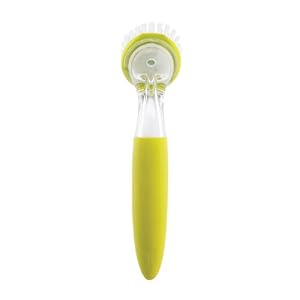
Dishes seem to appear out of thin air. It is still a mystery to me. Nevertheless, I feel like I am always doing dishes. This is only made more frustrating by lack luster scrub brushes. I like the kind that hold the soap. I have tried every brand made. Expensive, inexpensive, big and little. Brand name and no name. They have all adorned our kitchen sink. They all leak and the scrubbers always fall off.

A few months ago my husband came home with a little gift for the household.

Chef'n 401-106-004 CleanGenuity Sudster Wand Brush with Soap Dispenser, Avocado
Yep, it's a dish brush. This one made by Chef'n. I said thank you, but expressed my doubts. I was sure it would be just like all the others.

Boy was I wrong. I filled it up with soap and when I came into the kitchen the next morning,
ALL THE SOAP WAS STILL IN THE BRUSH. Every drop. Nothing had leaked out. Not one drop.

It actually makes the dishes more fun to wash.
Easy to fill, the brush lasts forever, and it DOES NOT FALL OFF WITH USE. It screws on and stays put.

It is not expensive and you can order it online. Plus, you can order replacement heads. We have also tried the foam heads. They are great, but over time the glue does weaken. I prefer the brush.

It also comes in a great red color if you don't really like the green. Go ahead, give it a try.
Is it pathetic that a good dish brush adds sunshine to my day?
Chef'n CleanGenuity Sudster Wand Brush, Rock Candy Color
SECOND

January leaves me wanting food that is lighter. After the holidays I am ready for something different.

I introduce to you the best winter (or summer) salad around. I mean, this is good. So good it is addicting. You don't want to stop eating it. Even better, it is elegant enough for a dinner party, and tasty enough that your kids will ask for seconds. (It would be perfect for a special Valentine Dinner for your loved one.)

Pear Parmesan Salad.

Romain Lettuce (If I am serving this to adults only, I use Organic Greens)
Parmesan Cheese (NOT pre-grated)
Pears
Cashews

Dressing
5 Tbls. Extra Virgin Olive Oil
5 Tbsp. Balsamic Vinegar
1 tsp Dijon Mustard
1 tsp Honey
1 Tbsp Diced Green Onions

Make your dressing.
Wisk your oil and vinegar together until combined. Add the mustard, honey and green onions. It is not tricky. I usually put all the ingredients in together and wisk away. I double the dressing recipe when I make it.

Cut up or tear your lettuce.
Use your carrot peeler on your parmesan cheese to create long thin strips.
Dice your pears,
and I like to use whole cashews.

At home I put everything in a bowl and add the dressing. Toss and serve.

When I am serving this for a more formal occasion, I like to make each salad on individual plates so everyone gets enough of the good stuff. (the pears, cashews and cheese.) Yum.

Trust me, this will make your January less gloomy.

How do you feel about January?
Do you have a favorite "something" right now? Do Share.


I didn't receive any compensation for recommending the dish brush. Chef'n has no idea who I am. I just really like it and wanted to share the great find with all of you. 

Thursday

FAMILY FUN FRIDAY! Gingerbread Houses

Every year, before Christmas, our family gets together to make gingerbread houses. It is one of our family's favorite holiday traditions. 

You Will Need
*Graham Crackers.
*Anything and Everything for decorating.
*Cement Frosting. Recipe to Follow. 
*Cardboard covered in tin foil. One large piece for every person.


Take your cardboard and cover it in tinfoil. This will be your base. 

Gather all the GOODS. We open the panty and grab everything we can see. This is a perfect way to use left over Halloween Candy too.

Make the Frosting. Let me tell you. This is the best gingerbread house frosting EVER. Works every time and it tastes good (for when you have to lick your hands).

1 Batch of Cement Frosting. 
1lb. powdered sugar
3 egg whites
1/2 tsp Cream of Tartar.

Add all together and beat on medium high speed for 7-9 minutes. I always beat for 9 minutes. Put it into a piping bag (or a ziplock will work), snip the end to make a tip, and start decorating. 
There were 8 people making houses tonight and I made 4 batches of the frosting. You don't have to make each batch separately. I put the ingredients for all four batches in together.
Give everyone a piece of cardboard, a pack of graham crackers and a bag of frosting. 

LET THE FUN BEGIN!!!
Just getting started. Look at that concentration.  


***FUN MODIFICATION***
To switch things up a bit. Put the names of different buildings into a hat and let everyone choose what it is they are going to make. For example. Town hall, post office, grocery store (general store), church, house, etc. What ever you pick is what you make. When everyone is done you will have made your own little town. You can even get a cloth, or big board and put everything on display. Once everyone is done with their buildings, help make roads and street signs. Don't forget the trees. Sometimes it is hard for people to think of something to do. This will help give some structure and guidelines. 


Have a wonderful weekend.
Christmas is only a week away. Yikes!


Wednesday

Bedtime Battles


After a full day with kids, minding our patience and trying to be creative, loving, attentive and understanding, it seems that when the bedtime battles begin, our patience goes out the window. This is a hard time of day for many families.

I offer some suggestions to make getting your little ones in bed easier.

First, understand how much sleep your children should be getting each night.
A three year old should be getting about 12 hours of sleep total, that includes naps.
Four year olds, 11 and 1/2 hours of sleep.
Five year olds, 11 hours of sleep.
Six and Seven year olds should still be getting about 11 hours of sleep.
Eight and Nine year olds, 10 hours
Ten year olds, still about 10 hours.
Thirteen year olds, 9 hours.
(Ferber, R. 2006)


Also consider that sleep breeds sleep. There is this misnomer that if you keep kids up so they are extra tired, they will sleep better and longer. Not necessarily the case. Haven't you ever put your child to bed late and they don't sleep in, instead they wake up at the same time they always do? Instead, recognize that the more your child sleeps, the more your child will sleep.
  • Set a bed time and STICK WITH IT. This is so important. Don't let bed be whenever. Set a time that is best for your child and put them to bed at that time every night. The more lenient you are with bed time, the more bedtime battles.
  • If you are trying to establish a new bed time, maybe because you have been putting your child to bed too late and you are trying to change that, make the adjustment gradually. You can't make bed time an hour earlier and expect children to automatically adjust. The best thing to do is over the course of a few weeks, move bed time up by 15 to 20 minutes each night until you have reached your desired bed time. This will allow your child's body to adjust to the new time gradually. There will be less stress involved for you and your child. 
  • ESTABLISH A BED TIME ROUTINE. I can't say enough about this. First, start your bedtime routine at least 30 MINUTES BEFORE you want your children to be in bed. This might sound like a lot, but think about it. They need time to wind down just like we do. Rushing through brushing teeth and prayers, only to throw them in bed and turn out the lights. Of course they are going to holler our name 20 times. They have not been allowed to do and say all that they need. 
Establish a routine, a sequence in which you will accomplish the same bedtime tasks every night. In our house we put on our pajama's and hang up our clothes; go to the bathroom, brush out teeth, read a book or two, spend a few minutes talking about the day and then we say prayers. Then with hugs and kisses we turn out the lights. We stick to the same order every night. If I suggest we do it any other way, my kids are the first to remind me that "we never brush our teeth before we put on our pajama's." By sticking to a routine, kids know what to expect, they also feel safe and secure because there is predictability. Kids like it when things are predictable. It brings comfort.

Bed time routines are also a great way to connect at the end of the day. My husband loves this time of the day because it is his time to connect with our kids. He hears what they did at school, they tell him what they are excited and worried about. They wrestle and tease. There is great power in this time of day. Embrace the opportunities to connect with your children. (Believe me I know this is hard when all you can think about is all the things that you will "finally" be able to do now that your kids are in bed. But don't rush it.)
  • Don't threaten. When kids get out of bed, or drag their feet at bed time, try not to say things like "If you don't get in bed right now, you can't play tomorrow." This will only make things worse. Instead, stick to a routine, give your kids lots of time to get ready for bed, and talk about the fun things that you will do, like "It's time to read a book, do you want to pick one out?". "Why don't you tell me what you liked best about today and then we will turn out the lights." These approaches will get you much better results. 
  • Teach children to sleep in their own beds. I recognize that there are many opinions surrounding this. You have to do what is best for your family. I still suggest that you put children in their own beds and teach them to sleep there. It is good for them, and for you and your spouse. If you have found yourself in this sticky situation and you are trying to get your toddlers to get back in their own beds, I suggest the firm approach. "You need to sleep in your bed." When children get out, with little to no words at all, return them to their beds. Be patient, breaking the habit will take time, but don't give in, not even one night.
  • Don't get 10 glasses of water. If you have put your little ones down for the night and they call you up for a drink, or because they want to "tell you something." Only respond once. Explain that they can have one request and that is all. They will learn to use that request wisely and pretty soon, the requests will stop. Going up every time they call will fuel the fire and drag the process out for hours. 
If as parents we can change the way we think about putting our kids to bed, it will really help with the bedtime battles. It can be a great time of day when we relax, connect, listen and teach. But, we have to be structured, and DILIGENT.

If bedtimes are already difficult in your family, remember that behavior can be modified. Don't give up hope, be patient and don't quit.

DO YOU HAVE BEDTIME BATTLES?

Family Volley

Tuesday

Technology, T.V. and Kids

Our son "pretending" to be Daddy. 2 years old. 
Dear Family Volley,

My niece and nephew visited the other day and had their heads buried in their DS games the entire visit.  Seemingly gone are the days of "go out and play" or engaging in polite conversation while visiting an aunt's house.  Do you think it is possible in this day and age to raise children who aren't hooked into cell phones, iPods, hand-held video games, TV, internet. . . . etc. etc.?  My baby's only 5 months old and I'm worried about the cumulative effect of all this as he grows up in this maxed out digital age.  We already limit the amount the TV is on.  In the grand scheme of "raising kids" where is there room for compromise and what guidelines do current research/you suggest following?

Thank you,

Nichole

______________-----------------------____________________
Nichole,
Thanks for the question. This is a hot topic.


Funny thing, in March I had a parent teacher conference for our daughter. I was in the hall, waiting my turn, with 2, two year old twins. Their parents were in a conference and they were waiting. They were both playing video games on iPhones. I could not believe it. They ran them just like if an adult were at the controls. Playing games, watching Sesame Street on YouTube, the little boy even called his grandma. It was obvious that they played with them a lot. Given what I teach about TV and technology, this was very hard to watch.


In class, I spend a number of lectures teaching students about TV, technology, children and families. Mostly we talk about how there are better ways for families and individuals to spend their time. I always have a few students that really struggle with what the research teaches. That's okay, I appreciate the opinions. 


So... What do we know about screen time and kids. 
The American Academy of Pediatrics does not recommend television for children age 2 or younger. For older children, the Academy recommends no more than 1-2 hours per day of educational, nonviolent programs. This includes any screen time. Video games, Computers etc. 


Children, regardless of age, are always learning new things. The first two years of life are especially important in the growth and development of a child's brain. During these impressionable years, children need to have positive interaction with children and adults. 


Too much TV can negatively affect brain development, especially when children are learning to talk and play.  


Although there are good things on TV, playing, reading, and spending time with family and friends are much healthier than sitting in front of a TV or computer screen. 


Children who watch excessive amounts of TV tend to be more aggressive. 


As a result of too much time spent with video games, TV, and technology, children are not spending time outside any more. It has become so bad that children are now being diagnosed with Nature Deficit Disorder. 


There are direct correlations between obesity and excessive involvement with TV and video games.


Counselors are spending a lot of time dealing with adults, especially men in their 20's who are addicted to video games. These addictions are tearing families apart. 


Research has shown that children who watch excessive amounts of TV only have an attention span that lasts as long as a show before a commercial. Let me explain. Most shows play for about 7 minutes and then there are commercials for 2 minutes. Children are only able to focus, pay attention and engage for 7 minutes, then they need a break before they are able to concentrate again. You can understand how this is not good.


Children who have excessive screen time have a smaller vocabulary, can struggle more with reading, have trouble being creative and imagining. (Why you ask? Television viewing requires little creative thought, or imagination and usually inhibits communication between viewers.)


As far as research, This is just scratching the surface.


What to do then? Does that mean that we hide everything technology and throw out the TV's? Are there zero benefits from technology? Do I have to become some sort of super mom so that I have perfect activities planned for my children every hour of every day so that they never watch TV? 

Technology is the way of the future. It is necessary. It is not going any where. We have to teach our children how to use technology. The Key: Moderation


Technology offers our families and children great things. We need it, we rely on it, we fall behind when we don't understand it.  We can't keep children from it, but we can monitor, moderate and limit. 


Too much technology in the home is one of the biggest drains on the lives of American Families. To combat this drain I offer two suggestions.
1. Make better use of your time. 
There are things that members of your family all do. Eat for example. Find ways to do these things together. Hold family dinner. Get ready for bed together. Establish a routine and stick to it. Include reading in your bedtime routine. It is one of the best things you can do for your children.
2. Carve time out from other activities. Tame Technology.
Although we need technology, we can need it a little less. Even if you turn the TV off for 15 minutes a day, that is 15 minutes that can be spent in more productive pursuits. 


Other suggestions:
  • Hold a family media fast (no media for a day/week/month). You will see your family transform. We do this a few times a year. We also have a rule that there is no TV before school. It has been one of the best rules we have ever made. 
  • Record the shows your family wants to watch. Fast forward through commercials and pause to hold discussions. 
  • Plan your TV watching a week ahead of time. Only watch those shows you planned to watch.
  • If the movie your kids want to watch is also a book, read the book to them instead of watching the movie. 
  • Keep all "screens'" in common areas in your home so that they can be monitored. 
  • Turn the TV off during family meals.
  • Establish tech time. Our kids can spend 30 minutes a day with technology. They have to decide if that will be a TV show, computer games, the Wii, or a little of each. When 30 minutes is up, that is it. 
  • Make other options readily available. We have a list of activities on our fridge. Our family sat down and made the list together. Everything from playing Candy Land to making cookies, riding bikes to reading or playing with side walk chalk. We have a list for inside activities and outside activities. When the kids think technology is the only option or they say they are bored, we go to the fridge, pour a glass of milk and sit down to look at the list. There is always something that sounds more fun than TV. 
  • Interact with your kids. Laugh, be silly, be spontaneous. Be willing to put aside the chores to play. 
Keeping our children from technology is doing them a disservice. Letting them drown in technology is also a disservice.
We have to teach them moderation so that our children can hold a conversation, build a tree fort, and work an iPad.


I love the quote by Max Frische. He said "Technology is a way of organizing the Universe so that man doesn't have to experience it". Kids watch sports instead of playing them. Kids play video games so they don't have to go outside and be creative.  Living through technology is not really living. 


We could go on and on. It comes down to moderation. There is such a thing as too much and too little. 


Family Volley


What do you think, technology, friend or foe?


Designed By: Wacky Jacqui's Designs